
Key Takeaways
- Many employers use ITIL Foundation as a hiring filter for IT service management and support roles.
- ITIL teaches the language of business value, not just technical support processes.
- The framework now extends beyond IT, influencing operations, HR, customer success, and digital service delivery.
- ITIL-certified professionals remain highly competitive in Managed Service Providers (MSPs), finance, healthcare tech, and enterprise IT environments.
- ITIL-certified professionals typically command a 15-20% salary increase over non-certified peers.
TL;DR
An ITIL® Foundation certification can open doors to roles such as Service Desk Manager, Incident Manager, Change Coordinator, Problem Manager, and Service Delivery Analyst. Beyond technical support, ITIL is increasingly valuable for Project Managers, Business Analysts, Customer Success teams, and operations professionals who need to align technology services with business outcomes.
In 2026, ITIL is no longer viewed as “just another certification.” It has become a foundational framework for organizations focused on digital transformation, governance, service reliability, and value co-creation.
The Strategic Value of ITIL in 2026
In the evolving landscape of Information Technology, the most frequent inquiry from aspiring professionals is:
What jobs can I actually get with ITIL Foundation certification?
Industry data confirms that ITIL 4 and ITIL 5 are not merely a credential but a universal language of business value. By moving the focus from "technical fixes" to "service management," this framework allows professionals to operate at a strategic level within any organization.
According to PeopleCert, ITIL is designed to help organizations “improve outcomes, reliability, and value creation” across digital products and services.
PeopleCert also describes ITIL as a framework that helps professionals “excel in essential IT service management” while enabling organizations to align technology operations with evolving business needs.
This shift is exactly why ITIL Foundation remains relevant in today’s market: it teaches professionals how to think in terms of services, outcomes, governance, and continual improvement - not just troubleshooting.
Where ITIL Fits in the IT Organization
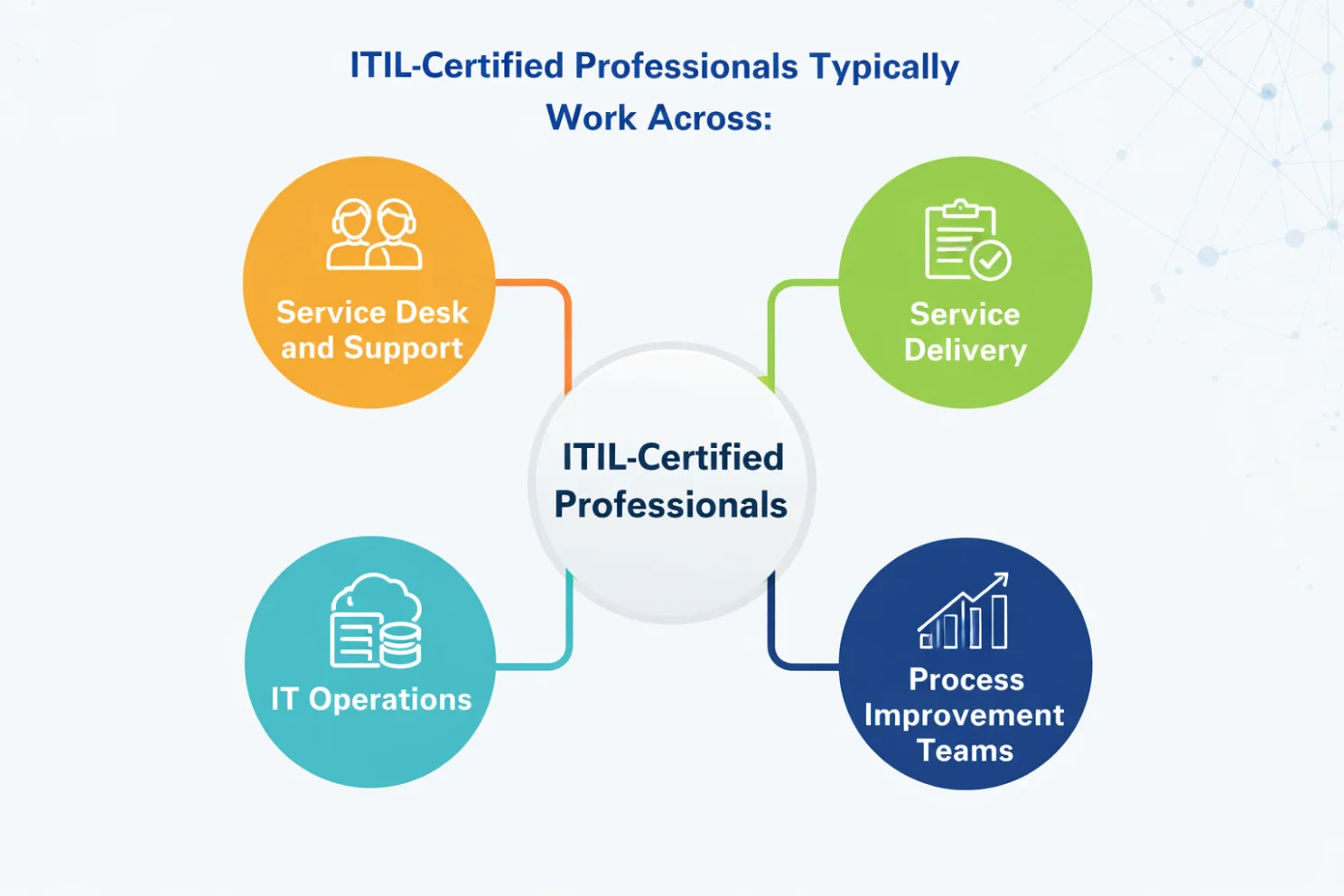
ITIL-certified professionals typically work across:
- Service Desk and Support
- IT Operations
- Service Delivery
- Process Improvement Teams
Top Jobs You Can Get with ITIL Foundation Certification
1. Service Desk Analyst
Role: First point of contact for IT issues
What You Do:
- Handle incidents and service requests
- Provide technical support
- Ensure quick resolution of issues
Why ITIL Helps: You understand incident management and service workflows.
2. IT Support Specialist
Role: Provide technical support across systems and users
What You Do:
- Troubleshoot hardware and software issues
- Maintain IT systems
- Support end-users
Why ITIL Helps: You follow structured processes for consistent support delivery.
3. Incident Analyst / Incident Manager
Role: Manage and resolve IT incidents efficiently
What You Do:
- Track and prioritize incidents
- Minimize service disruptions
- Coordinate with technical teams
Why ITIL Helps: ITIL provides best practices for incident management and escalation.
4. Change Coordinator / Change Analyst
Role: Manage changes in IT systems
What You Do:
- Evaluate risks of changes
- Coordinate approvals
- Ensure smooth implementation
Why ITIL Helps: You understand change enablement and risk control.
5. Service Delivery Coordinator
Role: Ensure IT services meet business expectations
What You Do:
- Monitor service performance
- Coordinate between teams
- Ensure SLAs are met
Why ITIL Helps: You focus on value delivery and customer experience.
6. IT Operations Analyst
Role: Support daily IT operations
What You Do:
- Monitor systems and performance
- Manage infrastructure support
- Ensure service continuity
Why ITIL Helps: You understand operational workflows and service stability.
7. Problem Analyst
Role: Identify root causes of recurring issues
What You Do:
- Analyze incidents
- Prevent future issues
- Improve system reliability
Why ITIL Helps: You apply problem management principles.
Job Roles and Career Progression
Level | Job Roles | Career Path |
|---|---|---|
Entry-Level | Service Desk Analyst, IT Support | Foundation for ITSM |
Mid-Level | Incident Manager, Change Analyst | Process ownership |
Advanced | Service Delivery Manager, IT Manager | Leadership roles |
Why Employers Value ITIL Certification
** Standardized Knowledge**
Employers trust ITIL-certified professionals to follow proven frameworks.
** Improved Service Quality**
ITIL focuses on delivering consistent and reliable services.
** Better Communication**
ITIL professionals can align IT with business needs.
** Process Efficiency**
Expanding the Horizon: Non-Technical Career Pivots
The ITIL 4 framework is increasingly applied outside of traditional IT silos, making it a powerful tool for career transitions.
The "Power Couple": ITIL + PMP
Many professionals mistakenly believe ITIL is only for technical support. In reality, the framework's focus on the Service Value Chain makes it highly applicable to broader business roles.
Evidence from global recruitment trends suggests that the most hireable candidates often possess a combination of ITIL and PMP (Project Management Professional) certifications. While PMP provides the structure to build new initiatives, ITIL ensures those initiatives deliver continuous value once they enter the operational phase.
Rebranding Experience for New Roles
Professionals transitioning from sales or administrative backgrounds can use ITIL terminology to reframe their expertise:
Previous Background | ITIL-Aligned Career Direction |
|---|---|
Sales | Customer Success / Service Relationship Management |
Administration | Service Operations / Configuration Management |
Marketing | Workflow Optimization / Digital Operations |
Customer Service | Service Desk / Experience Management |
Because ITIL focuses heavily on value co-creation, communication, and service relationships, many transferable skills become easier to position professionally.
PeopleCert describes value co-creation as a critical part of stakeholder engagement and customer relationship management within modern service organizations.
The 2026 Outlook: AI and Human Governance
As AI automates routine technical tasks like ticket logging, the human element of service management becomes more valuable. The industry now requires professionals who can govern automated systems and ensure the Service Value System (SVS) remains aligned with human outcomes.
Industry Demand Snapshot
Industry | Demand Level | Key ITIL Focus |
|---|---|---|
Financial Services | Critical | Change Governance & Risk |
Managed Service Providers (MSPs) | Mandatory | SLAs & Service Operations |
Healthcare Technology | High | Availability & Continuity |
Enterprise SaaS | High | Incident & Problem Management |
Government & Public Sector | Strong | Governance & Compliance |
Final Thoughts
ITIL Foundation Certification opens the door to a wide range of roles in IT service management. While it may not instantly land you a senior position, it provides the structured knowledge and credibility needed to start and grow your career in IT.
If you are looking to:
- Enter the IT industry
- Improve your service management skills
- Move into higher-value roles
then ITIL Foundation is a strong and strategic starting point. Don't leave your career to chance. Join the thousands of professionals who have leveled up with PassionIT Group.
Register for the ITIL® Foundation (Version 5) Course Today
FAQs