Back to the Future: A Guide to IT Organization Structures Using ITIL
Rich Petti, ITIL Master, revisits ITILv3 to answer the hardest IT structure questions: org models, CIO reporting, and whether you need a Service Management Office.

Rich Petti
Contributor
Key Takeaways
- There is no single best IT organization structure. Every organization must choose based on its unique vision, purpose, scale, culture, and strategy.
- ITILv3 provides more organizational guidance than ITIL®4 or ITIL® (V5) do — revisiting Iv3 adds a valuable layer for today's decisions.
- If your organization adopts a portfolio of best practices and standards, a matrix structure is most likely your best fit.
- A Service Management Office (SMO) is a strategic capability, not an overhead function. Most ITIL-adopting organizations benefit from having one.
- Where the CIO and CTO report sends a clear signal about how strategically IT is valued — and that signal matters to the whole organization.
- Organization design is an iterative activity. PESTLE, VUCA environments, and rapid technology change means that organization structures must evolve continuously.
Organization structure is never a solved problem. It is a living design that must evolve as the business evolves, as technology changes, and as the demands on IT shift from operational cost center to strategic value creator. The organizations that get this right are the ones that treat structure not as an org chart exercise, but as a strategic capability decision, revisited regularly, guided by clear criteria, and never mistaken for a permanent solution. Therefore, competency in organizational change management is essential.
— Rich Petti — ITIL Master, Ambassador & Assessor | PassionIT Group
Introduction: Why Go Back to the Future?
Reading in the media about organization changes and staff reductions due to automation brought back to mind twelve years of conversations about organization design and change management working in ITIL®v3. Those conversations consistently considered the same questions:
The Questions That Never Go Away
- What is the best IT organization structure?
- Where should the IT organization report?
- Who should the CISO, CTO, and CIO report to?
- Should we have a Service Management Office?
During the past seven years teaching ITIL®4 and during the first six months of this year studying, certifying, and teaching five of the new ITIL®(Version 5) courses, I found there is only generic guidance about IT organization structures and models in the Iv4 and Iv5 frameworks.
This blog adds a layer of information to ITIL’s Organizations and People Dimension by going back to ITILv3 to guide a conversation about IT organizational models and methods, and is a response to the questions above, which I have encountered repeatedly across IT maturity assessments, consulting, certification programs, presentations, training, and workshops.
ITIL’s First Dimension: Organizations and People
One of the Four Dimensions of Service Management, the Organizations and People Dimension covers how an organization’s structure, workforce capacity and competency, roles and responsibilities, leader capabilities, and culture all contribute to the delivery and co-creation of value through IT services.
Source: ITIL®4 & ITIL®(Version 5)
The Six Macro-Level IT Organization Models
There are six commonly used macro-level organization models. These archetypes can be combined to cover the breadth and depth of an organization’s vision, purpose, scale, and scope, including on-shore, off-shore, near-shore, owned, retained, leased, or outsourced functions, and services.
MODEL 1 - Hierarchical
A legacy internal model where IT serves all business units in the same manner as Finance, HR, Legal, and Facilities. A classic line and staff approach with three or more vertical management levels.
MODEL 2 - Functional
Three or more vertical levels of divisions and departments, each consisting of its own horizontal work-focused groups, teams, and units organized around specific capabilities.
MODEL 3 - Matrix
A grid of horizontal and vertical managed functions with dual reporting, enabling collaboration across disciplines without full centralization.
MODEL 4 - Flat
Horizontal functions within just two vertical levels, minimizing management layers to increase speed and direct communication.
MODEL 5 - Network
Relational connections across, within, and between functions and levels, internal or external,suited for highly collaborative and distributed organizations.
MODEL 6 - Holacratic
Decentralized or situational functions using self-managed teams that may be used within or between other internal or external organization types.
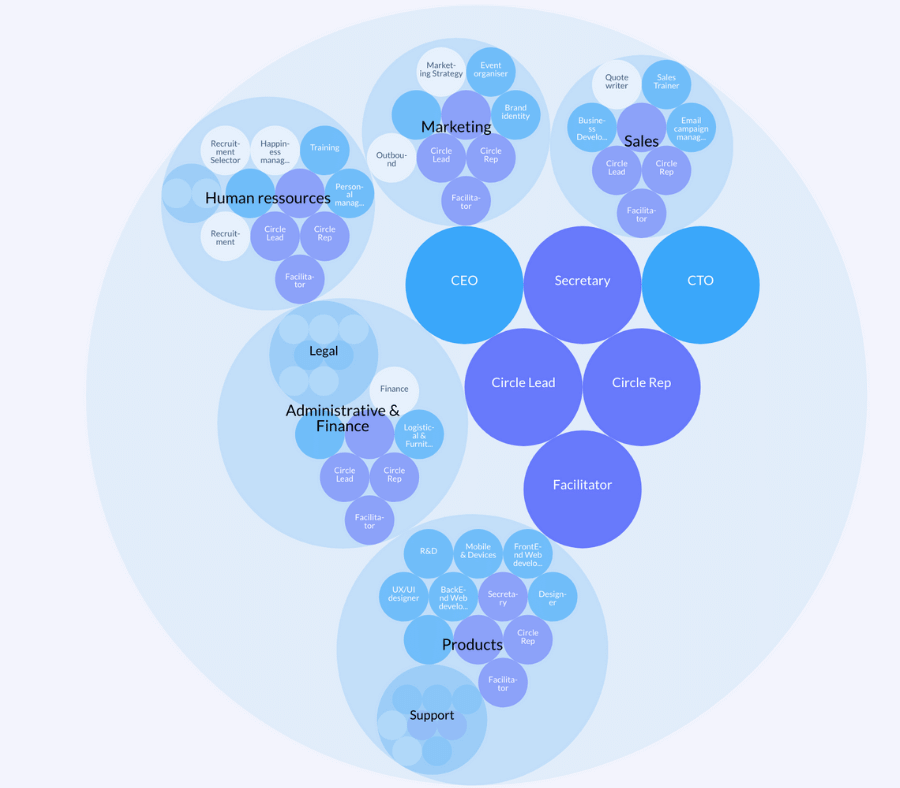
Typical IT functions to consider for product vendors and service providers include strategy, product, service, development, transition, engineering, service desk, support, architecture, manufacturing, marketing, and sales. One or more of the assets, capabilities, or resources for any of these functions may be externally supplied or contracted.
For the remainder of this discussion, I will focus on the first three models, Hierarchical, Functional, and Matrix, as the primary choices for IT, with the remaining three as options as subsets of those first three.
The Six Macro-Level IT Organization Models
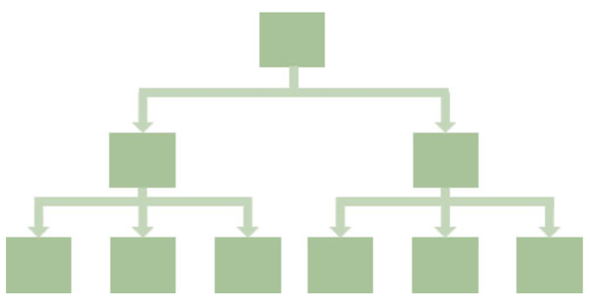
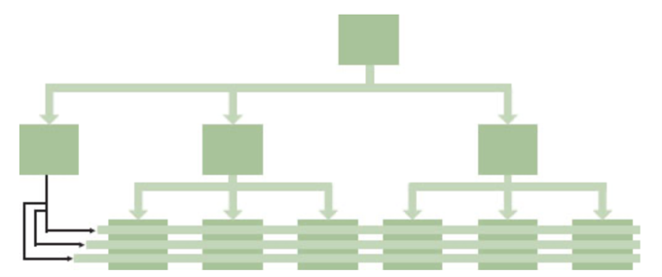
MODEL A - Hierarchical IT
Often three or more vertical levels of management that mirrors the business hierarchy — typically with strategic (executive), tactical (middle management), and operational (front-line management) levels. IT serves the entire business from a centralized structure, like how Finance, HR, or Legal serves all business units.
MODEL B - Functional IT
A model developed in response to wherever the business highly depends on IT. Parts of, or all, the IT capabilities or functions may be separate from, shared with, or melded into one, a group of, or all business units — working in coordination or delegation modes. This model is most common where specific business units have distinct, specialized technology needs.
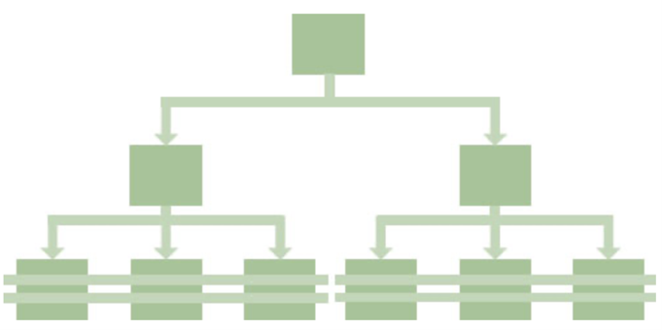
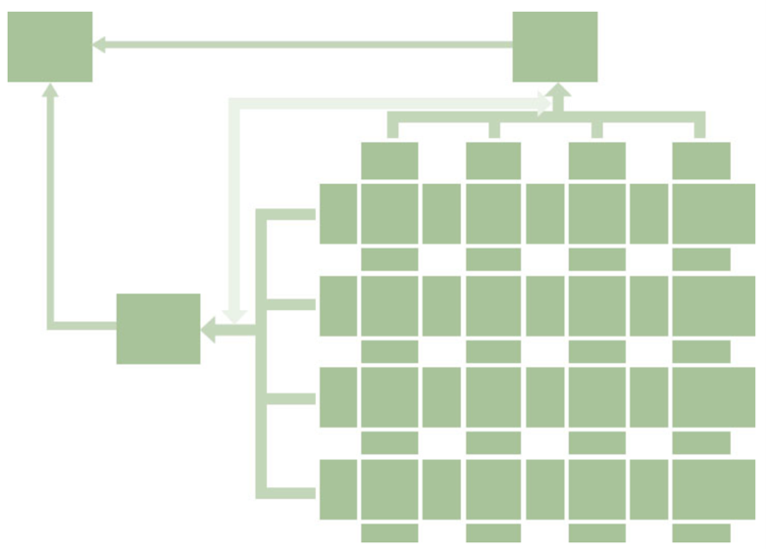
MODEL C - Matrix IT
An interwoven vertical and horizontal model with a mix of shared and cross-functional roles across internal and external IT functions, independent of organizational boundaries. The matrix model inherently contains elements of both hierarchical and functional models, and supports collaborative, self-managed, and cross-functional teams where they are needed.
In ITIL 4’s Practice Guides and ITIL(Version 5)‘s Product and Service textbooks, there is mention of organization roles and teams at various levels managing any one or more IT value chain activities. Owners and managers of Programs, Projects, Products, Services, Practices, Processes, Tools, Consumer Relationships, Support, Suppliers, Value Systems, Value Chains, and Value Streams may be at any level in an organization.
In the new Foundation textbook, we are asked to take a fresh look at the organizational framework from a service relationship and experience perspective. Examples are these two figures from that textbook:
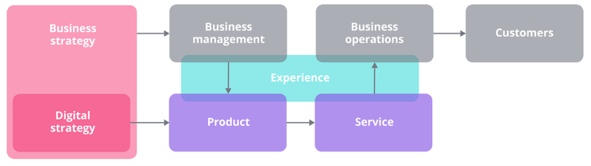
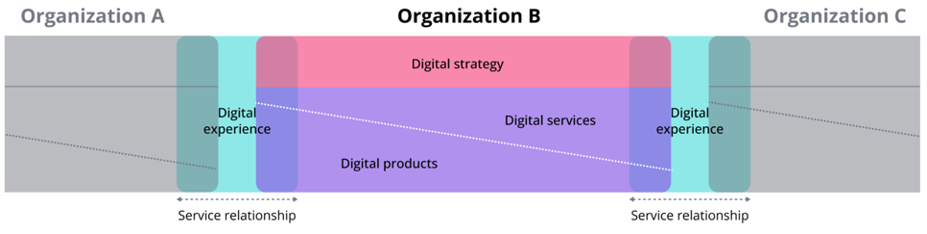
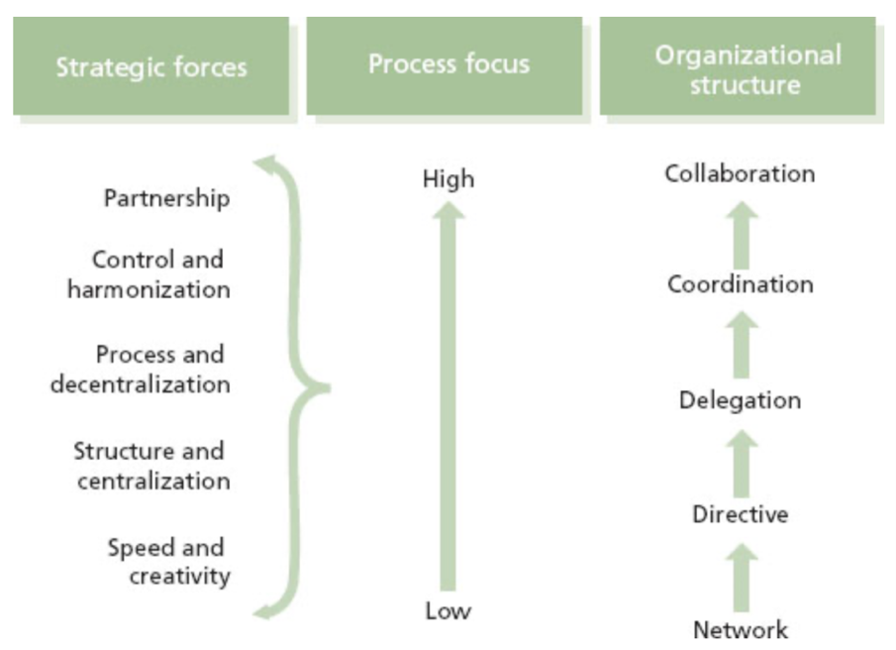
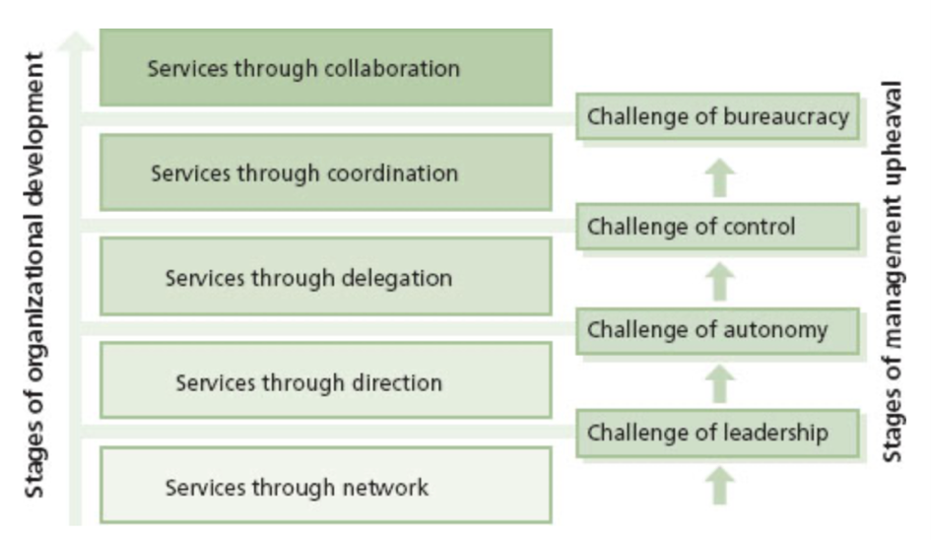
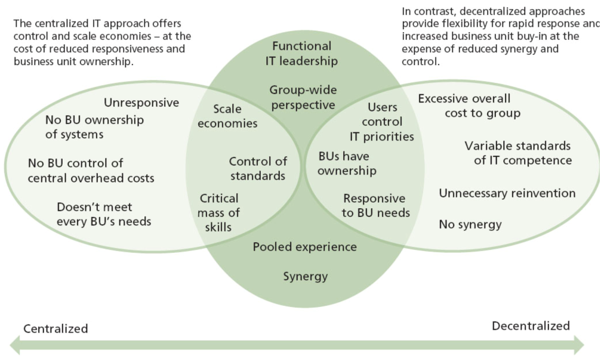
ITILv3 covered organization models in a bit more detail. Choosing a structure depends on strategy, practice/processes, centralization, and structural challenges as illustrated in the three figures below:
Service Provider Models
ITILv3’s Service Strategy introduced another lens for thinking about organizational structure: choosing from any one or combination of three service provider types.
ITIL’s Three Service Provider Types
- Type I — Internal: IT serves only the organization it belongs to. Often needed for core, sensitive, or strategically critical functions.
- Type II — Shared: IT serves multiple business units or organizations from a shared service model. Both Type I and II are frequently needed together, especially for internal Partnerships.
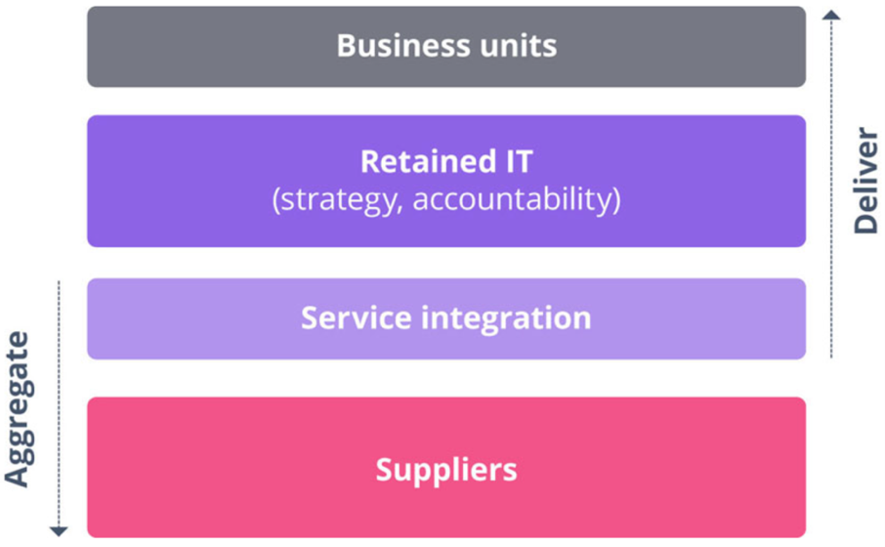
- Type III — External: Today represented by Managed Service Providers (MSPs), cloud providers (public, private, community, internal, external, and hybrid), and Service Integration and Management (SIAM) models that include both retained and external
Both Type I and II are still used for an internal IT organization, especially due to the complexity of emerging technology.
Today, Type III is often represented by Managed Service Provider (MSP), Cloud providers [public, private, community, internal, external & hybrid] and Service Integration and Management (SIAM) models that includes retained and external IT functions.
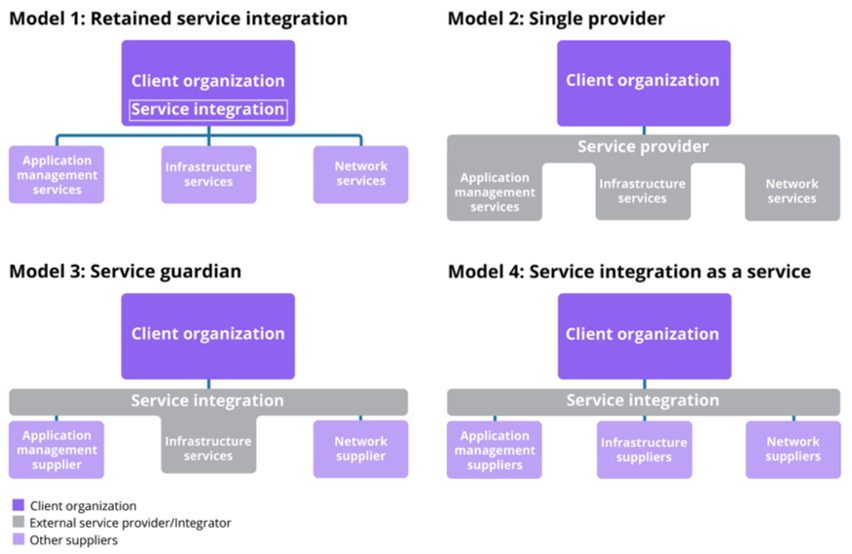
In Iv3’s Operation stage, examples of Operation organization design are shown in the three sample figures below, which you may have or wish to emulate in your organization.
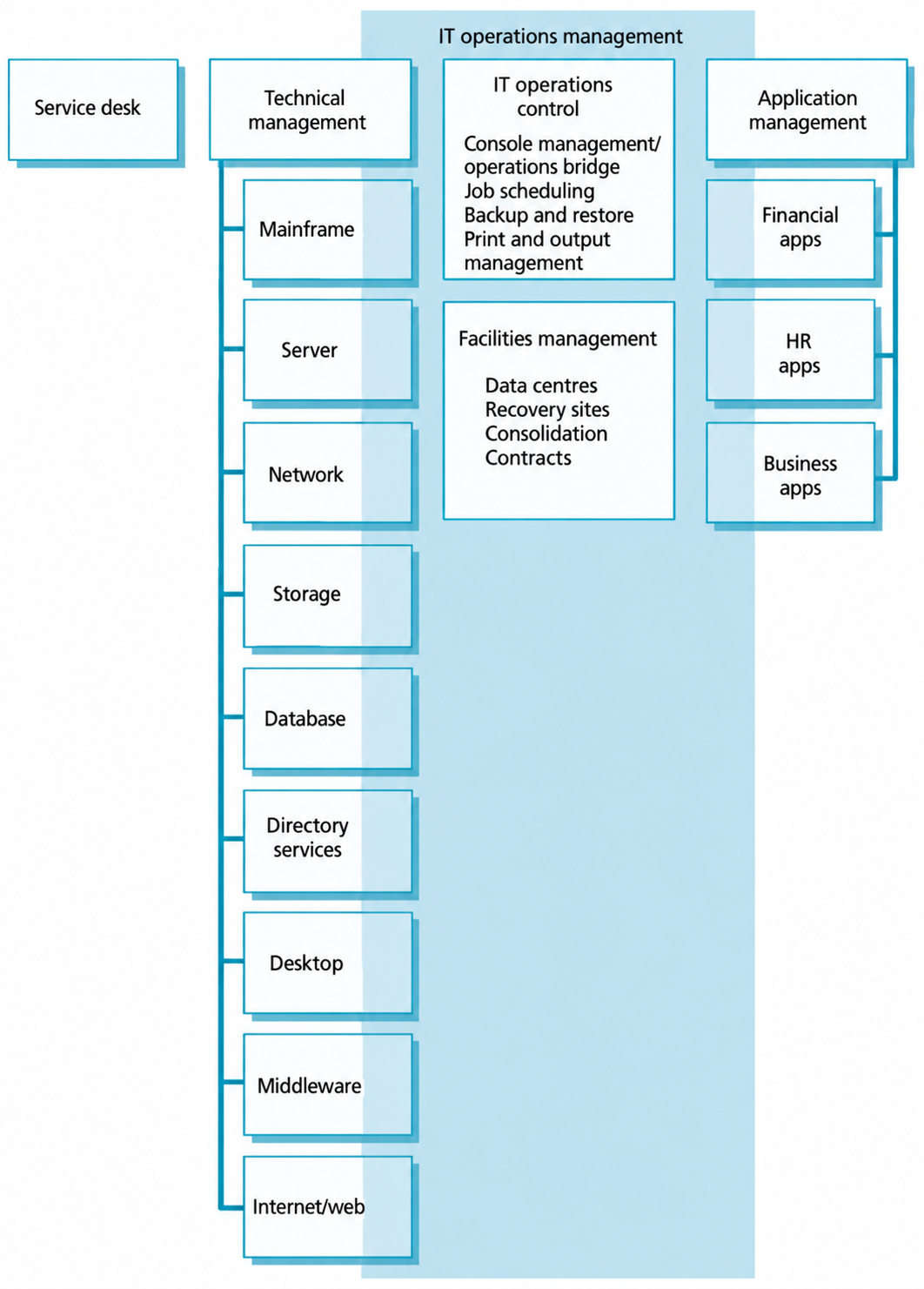
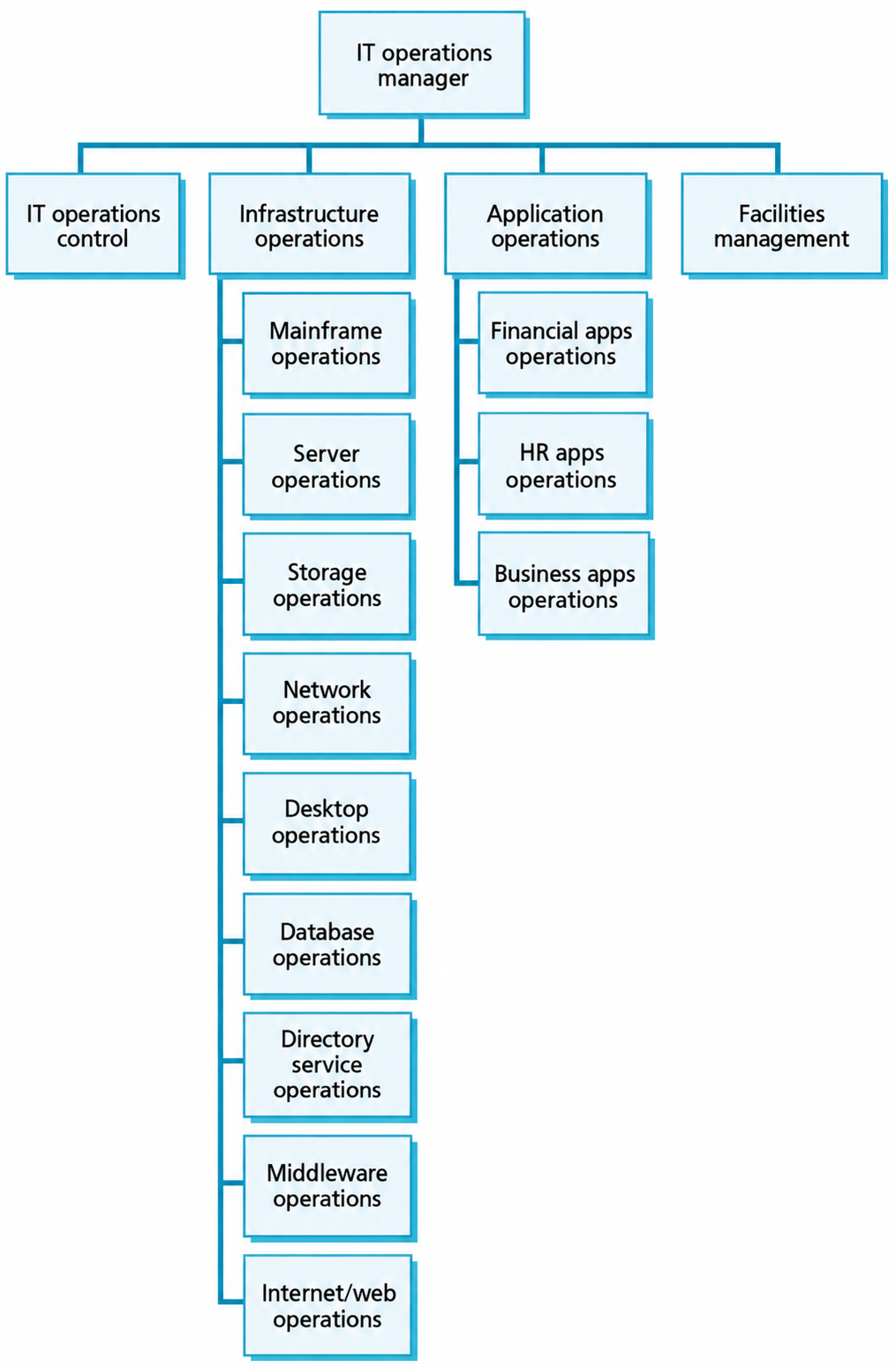
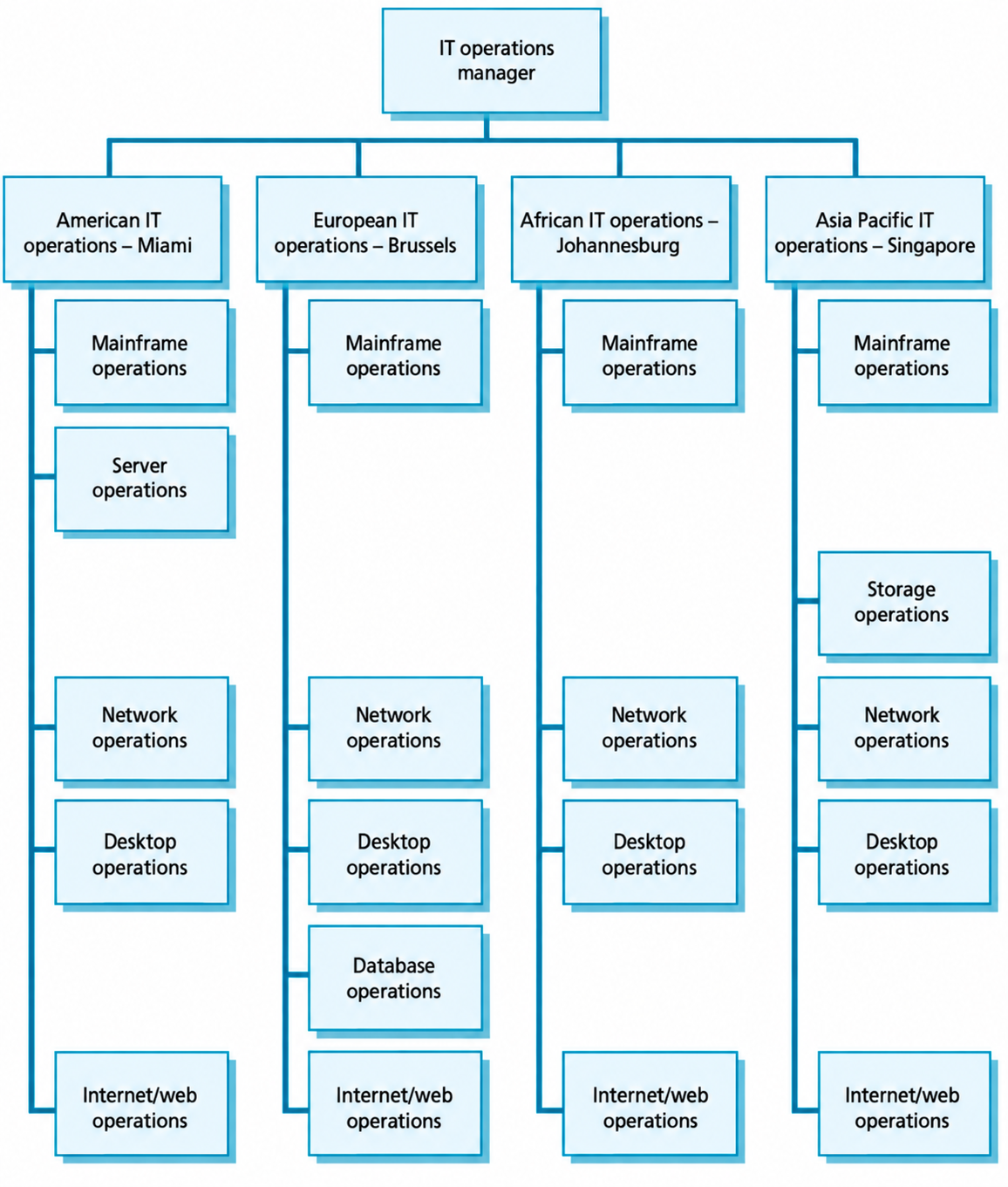
In I(V5), Applications Management functions and practices, especially for digital products and services, may support all the activities of the ITIL Value Chain (IVC) in a variety of ways.

In Iv3, the figure below presented an approach that you may find helpful to think about how you would design your org structure around Agile, SAFe, DevOps and ITIL(V5)’s IVC:
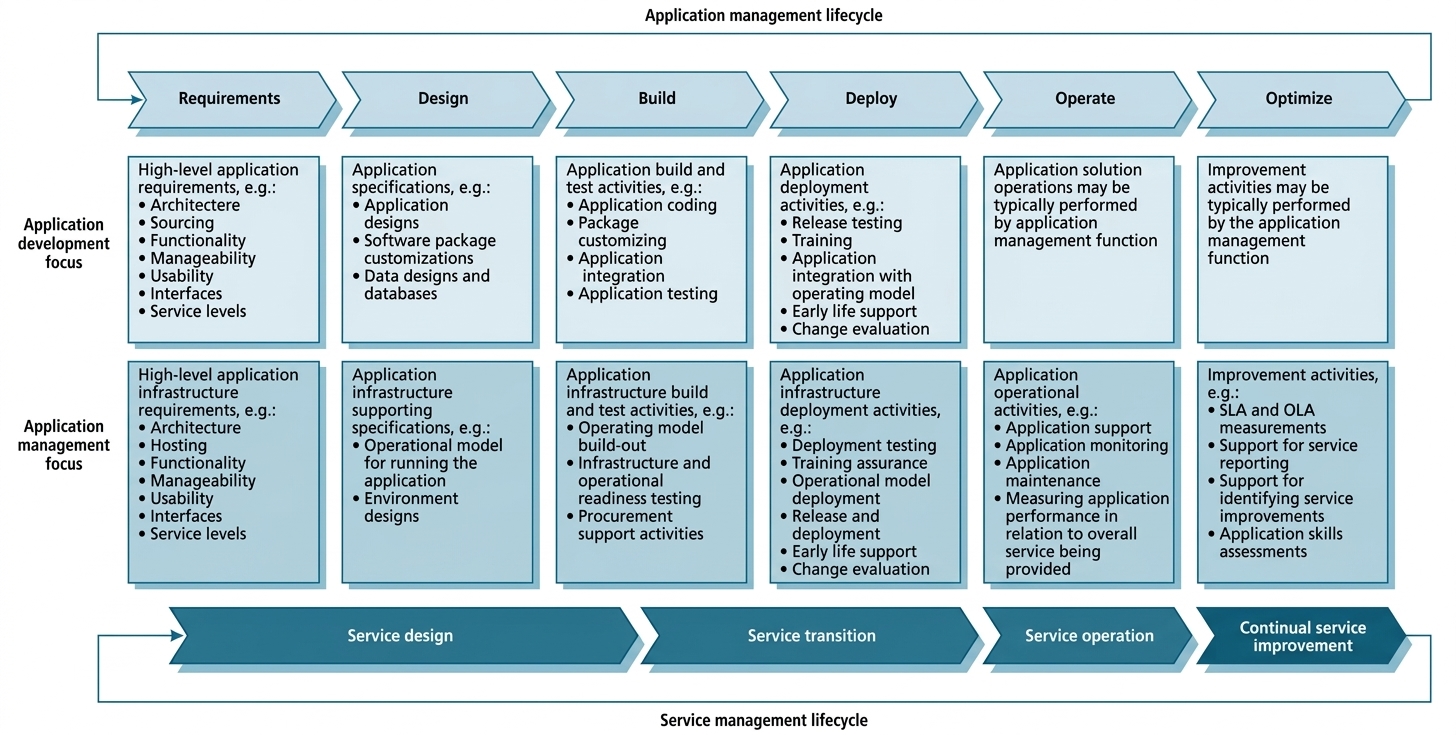
Iv3’s depiction of Operation Control functions/roles under Operations management, in various ways may support any of I(V5)’s eight IVC activities (i.e. modeling & prototyping in Design, testing in Build), with most of the effort in the Operate, Deliver, and Support activities of the IVC.
The I(V5) IVC Operate activity includes managing all internal infrastructure, operating systems, definitive applications, tools, specialized IT equipment, and interfaces to externally provided resources; all required to provision all IT Products and Services.
For that purpose, dedicated IT facilities may be required for the Operate, Deliver, and Support activities of the IVC. The outputs of the IVC Operate activity enables the IVC Deliver and Support activities.
The IT Organization and Facility Management
Iv3 also depicts IT Facilities management & functions under Operations management. There are three views with respect to IT’s requirements with facility management functions:
1. Dedicated facility needed to manage products, services, IT operations, functions, and teams
-
I4 and I(V5) say nothing about IT facilities except in I_4 Foundation:
“Infrastructure and platform management may also include the buildings and facilities an organization uses to run its IT infrastructure.”
2. Facility needed to manage IT used by business functions
3. Facility space needed to manage IT services used in common spaces
In turn, facility space for IT functions may be required in the org design to support computer dependent physical environments in operation used across all eight IVC activities such as:
- Computer rooms
- IT continuity solutions
- Copy/fax/printer/scan
- Data centers & private clouds
- Support of IT in closets, credenzas, desks or podiums
- Computerized environmental controls
- IT support for training, meeting, auditorium, conference, & theater equipment
- IT store, lab, test, build, & repair rooms
- Biz or IT manufacturing
- Telecommunication & telephony
- Network ops control & IT ops control
- Security & safety automation
Therefore, IT organizational structure requirements and plans for future org structure and functions/teams, needs to be tightly coupled with the business’ org design and plans and then both orgs would work collaboratively with internal &/or external facility management.
Back To the Future
When it comes to ITIL’s Organization & People Dimension, organization structure is one the many elements in that space.
As it is with all best practices, there is no prescriptive way to organize for one, nor even for like organizations. Each organization and its functions within need to consider their unique characteristics, to choose and design an org structure that will transform over time because of changing and evolving internal and external factors.
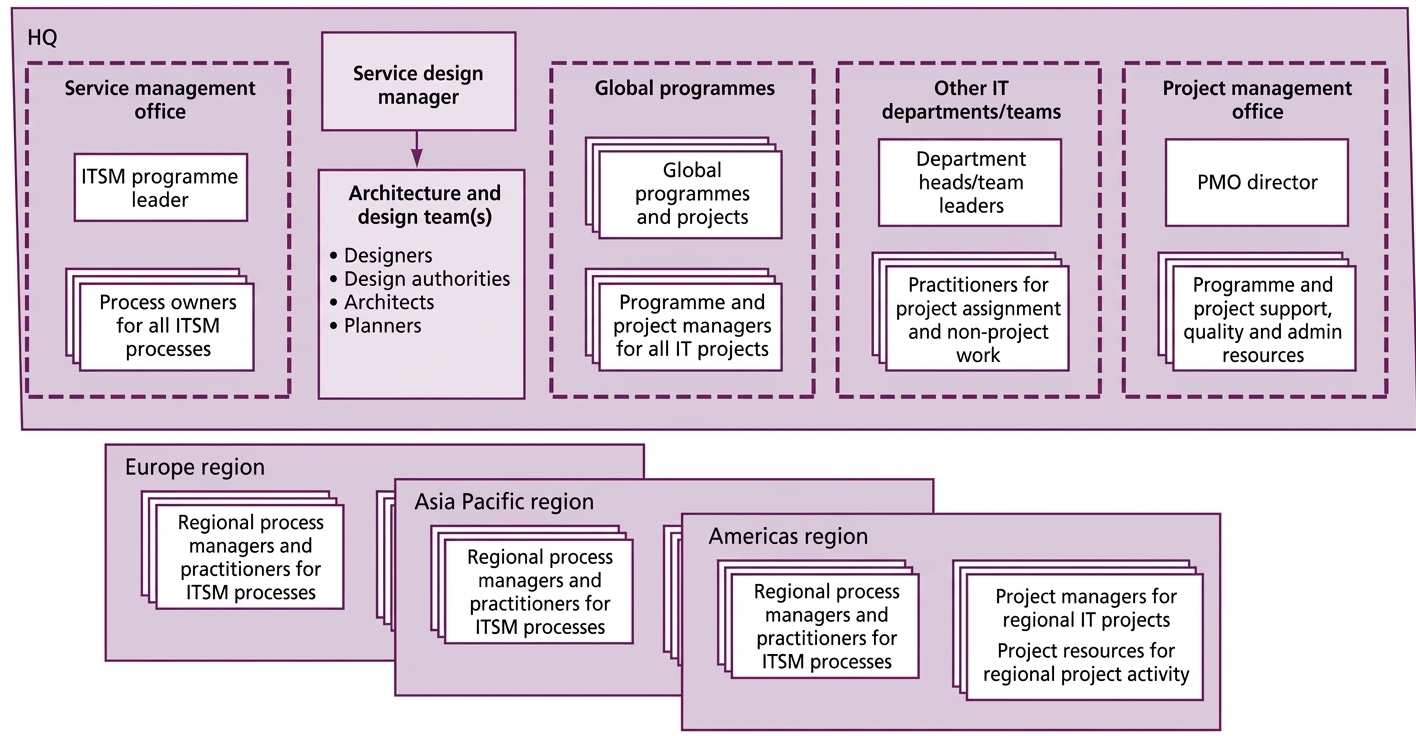
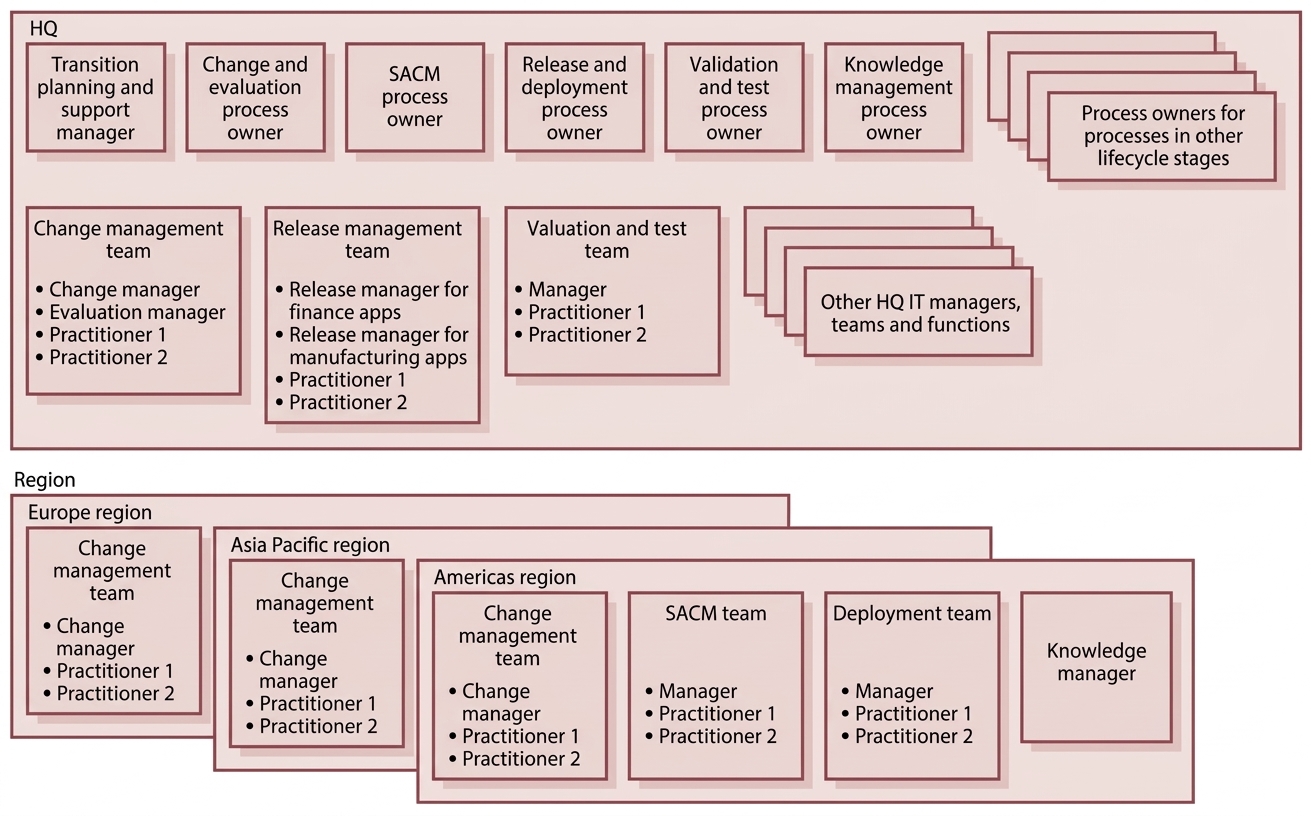
All ITIL ‘versions’ include organizational guidance, but going back to the future of Iv3, may help you imagine what possibilities are still available today to guide you thru to tomorrow.
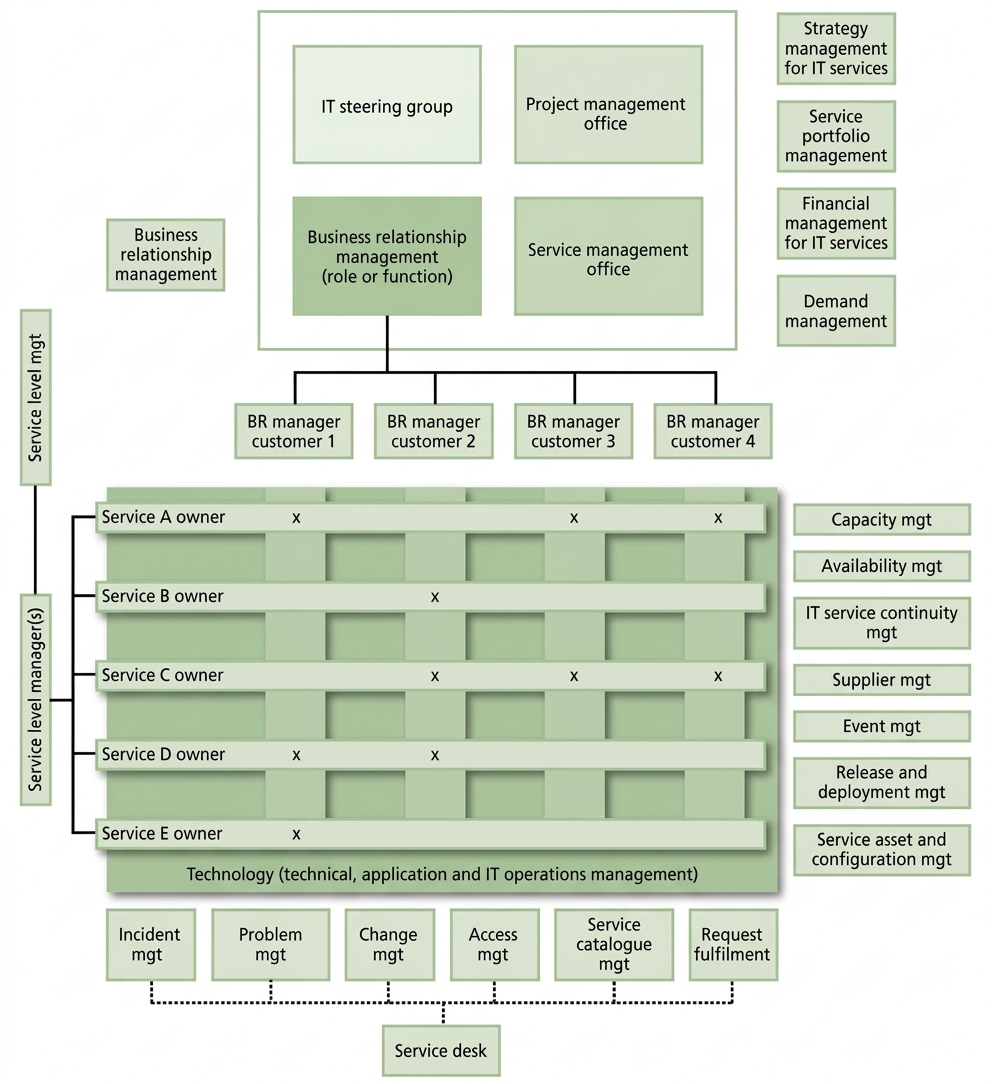
Over time, due to PESTLE factors, VUCA environments, and rapid changes in technology, internal and external business and IT organization structures will need to evolve, morph, or meld to be more responsive to the business. For example: if a manufacturing unit starts as the only business function using robotics and maintains its own IT unit, but then as robotics adoption grows across additional business units, a more centralized or mixed internal IT structure for that type of automation becomes necessary — with all or perhaps parts of that technology domain may be outsourced.
That is one of many reasons why Organization Change Management is a critical strategic capability that every organization must develop and maintain.
Criteria Checklist for Organization and Function Design
All organization and function designs need to consider criteria to manage the structures, the people within them, and their products, services, suppliers, and customers. The following criteria checklist, alliteratively using the letter C, provides a comprehensive framework for that evaluation:
CRITERION | COMMON CONSIDERATIONS |
|---|---|
1. Canvases | Business models based on vision, purpose, missions, and related strategies and policies |
2. Centralization | Based on need for autonomy, control, consistency, creativity, criticality, flexibility, spontaneity, synergy, and variability |
3. Collaboration | Cross-functional cooperation, consensus, communication, conflict management, sharing, and visibility |
4. Collections | Application, customer, product, project, service, supplier, practices/standards, and other portfolios |
5. Command | Theory X, Y, or Z; servant-leader and situational management skills and styles |
6. Communication | Models, methods, mediums, media, technology, tools, and audio/visual capabilities |
7. Community | Livability and compatibility of civic, public, and private societal factors where employees, consumers, and suppliers live, work, and play |
8. Competencies | Education, experience, certifications, and skill sets of leadership, individual contributors, consumers, suppliers, and stakeholders |
9. Competition | Based on discovery, research, markets, benchmarks, SWOT, and Wardley mapping |
10. Computerization | Levels and types of automation and tools to manage data, information, knowledge, practices, processes, workflows, and value streams |
11. Consumers | Customer, user, and sponsor types served; outcomes, product and service levels, value propositions, and desired relationships and experiences |
12. Contractors | External partners, suppliers, third parties, outsourcers, and vendors — their competencies, governance, structures, resources, and practices |
13. Control | Required for assets, audits, governance, health, risk, safety, and security |
14. Countries and Continents | PESTLE, culture, demographic, geographic, psychographic, and governance considerations; available resources, finance, culture, and language |
15. Coverage | Prime time, after hours, seasons, patterns of business activities, holidays, and service levels and hours |
16. Culture(s) | Guiding Principles, psychographics, norms, values, faith, and holidays of the community, countries, continents, stakeholders, consumers, and suppliers |
17. Current and Future Market Spaces | Strategies, tactics, objectives, and outcomes; business, relationship, and stakeholder analyses; proposals, perspectives, positions, and patterns |
Which Model to Choose: The Case for Matrix
If your organization adopts a collection of best practices and standards for the business and IT, then a matrix structure is most likely the best way to organize. A matrix model inherently has some elements of hierarchical and functional models, and supports collaborative, self-managed, and cross-functional teams where they are needed inside the matrix.
Direction of IT may come from an IT Steering Committee or Councils consisting of one or more business managers, IT Business Relationship Managers, the COO, plus direct reports to the CTO or CIO, the latter may serve as co-chairs, including a representative from the Service Management Office.
The Service Management Office: A Strategic Capability
A Service Management Office (SMO) may be one person, a certified ITIL Master, in a small organization, or for a larger organization, a team of two or more ITIL-certified practitioners. For example: a group consisting of a Practice Manager, Managing Professional, and Strategic Leader with one ITIL Master as the leader or working as a self-managed team.
What the SMO Does
- Be part of a center of excellence, total quality, or corporate improvement initiative
- Manage cross-functional continual improvement of IT
- Manage value system maturity, practice capability, and quality of value chain activities and value streams
- Participate in portfolio and governance reviews regarding IT
- Perform self-assessments of value system, value chain, value streams, practices, and standards
- Perform training on best practices, standards, value system, value chain, and value streams
- Monitor and report cross-functionally on IT-related CSFs, KPIs, metrics, and practice success factors
- Help prepare for internal and external audits
A matrixed SMO function formed in the fashion of a Program and Project Management Office (PPMO), or like a cross-functional unit/team/group for governance, is a more desirable structure for most organizations adopting ITIL.
Where the IT Organization Reports: The CIO Question
This approach has been common, especially in startups or small organizations, for IT to report into Finance. But over time, and in larger organizations, IT is often then seen as an operations cost center: the first place in line when costs need to be cut.
The shift has been to move the CIO from reporting to the CFO to reporting to the CEO; to signal IT’s strategic importance to the whole organization. This is what Howard Schultz describes in his book “Onward”, his deliberate decision as CEO of Starbucks to make that reporting change as a strategic statement.
In larger organizations, a pattern that works well is to add a CTO focused on strategy and future technology with a CIO more focused on current technology, products, services, improvement, and operations.
A Note on Continual Improvement Structures
Organizationally, ITIL’s guidance is to make Continual Improvement part of the organization’s culture. It may be represented as a standalone corporate function, a function matrixed across the organization, or embedded in a corporate center of excellence, total quality, a governance, a standard, or a Lean/Six Sigma team, with responsibility for IT’s improvements assigned to the SMO.
Back to the Future: Six Decisions for Your Organization
When it comes to ITIL’s Organizations and People Dimension, organization structure is one of many elements, and there is no prescriptive way to organize for one organization, let alone for similar organizations. Each organization and its functions need to consider their unique characteristics, choose their desired structure, and plan for that structure to transform over time because of changing internal and external factors.
All ITIL versions include organizational guidance, but going back to the future of ITILv3 may help you imagine what possibilities are available today and will guide you through to tomorrow. Just as strategy is never static, choosing and managing a business and IT organization structure to achieve the corporate vision, purpose, mission, strategy, tactics, and objectives is an iterative activity that must consider many criteria.
1. Review your criteria
Use the 17-criterion checklist above to identify what your organization should consider creating an IT organization structure that would best manage IT in alignment with the business and to improve co-creation of value.
2. Choose your IT organization structure
Decide which model, Hierarchical, Functional, Matrix, or Other, will best meet your criteria for where you are now and where you want to be in the future.
3. Decide on a Service Management Office
Determine whether to establish a matrixed SMO for improved alignment to and integration with the business, and what form it should take.
4. Decide the reporting structure
Determine to whom the ITSM/DPSM organization and the SMO should report, and what signal that reporting structure sends about IT’s strategic role.
5. Choose your supplier model
Strategically decide which combination of Type I (Internal), Type II (Shared), and Type III (External), Managed Service Provider, SIAM, or future supplier models best fits the business and supports decisions 1 through 4.
6. Plan for AI and next-generation technology
Look forward to the management of next-generation, leading-edge, and future technologies, particularly Artificial Intelligence, which will present IT organizational structure challenges that current models may not fully anticipate.
” Going back to the future for ITILv3’s organizational advice is not about nostalgia; it helps communicate and define today’s strategy. The organizational guidance that v3 provided was more detailed than what ITIL 4 and Version 5 have replaced it with, and today’s leaders making real decisions about reporting structures need that level of detail. The past is not obsolete. It is a resource to learn from for the future.”
— Rich Petti — ITIL Master, Ambassador & Assessor | PassionIT Group

ITIL® Product (Version 5)
Manage digital products as connected systems across their full lifecycle with the ITIL Product (Version 5) certification.
- Live, Instructor-led Virtual Class
- Official Exam Voucher Included
- Take2 Re-Sit Option Included
- Office Hours Support
- Digital Course Materials
- Certificate of Completion
FAQs
Frequently Asked Questions
What is the best IT organization structure?
What is ITIL's Organizations and People Dimension?
What is a Service Management Office (SMO) and does my organization need one?
Where should the CISO, CTO, and CIO report in an organization?
What is the difference between ITILv3’s organization guidance and that in ITIL_4 and ITIL(V5)?
What is a matrix IT organization structure?
The Writer
About the Author
Rich Petti
Contributor
Rich Petti is an ITIL Master, Ambassador, and Assessor with over 55 years of combined IT experience spanning the military and two major, worldwide computer manufacturer organizations. He entered the IT best practices conversation in May 2005 and has been a leading voice in ITSM, ITIL adoption ever since. With twelve years of facilitated conversations about IT organization change management that supports ITIL, across ITILv2, ITILv3, ITIL4, and ITIL(Version 5), Rich brings a unique blend of management, support, and technical perspectives to the questions most IT leaders are still wrestling with today.
Level Up
Related Courses
ITIL® Product (Version 5)
ITIL® Product (Version 5) is an advanced specialist certification that focuses on managing digital products as connected systems across their full lifecycle. Learn product strategy, ownership, value streams, and AI-aware product management aligned with the ITIL Value System.
ITIL® Service (Version 5)
ITIL® Service (Version 5) is an advanced specialist certification that focuses on the end-to-end service lifecycle in the digital era. Master service design, delivery, and continual improvement aligned with the ITIL Value System and AI-enabled service environments.
ITIL® Strategy (Version 5)
ITIL® Service (Version 5) is an advanced specialist certification that focuses on the end-to-end service lifecycle in the digital era. Master service design, delivery, and continual improvement aligned with the ITIL Value System and AI-enabled service environments.
ITIL® Transformation (Version 5)
ITIL® Transformation (Version 5) is an advanced specialist certification that equips leaders to direct, plan, and execute large-scale service transformation across digital products and services. Learn to align strategy, technology, and people to deliver durable change in the AI era.
ITIL® Foundation (Version 5)
Get 40% OFF ITIL® Foundation (Version 5). Master AI-driven ITSM through an accredited, two-day instructor-led course. Attend live online from anywhere or join us in person at our training office.
Keep Reading
Related Articles
Back to the Future: A Guide to IT Organization Structures Using ITIL
Rich Petti, ITIL Master, revisits ITILv3 to answer the hardest IT structure questions: org models, CIO reporting, and whether you need a Service Management Office.

What Do Jerry Maguire and ITIL Have in Common?
Michelle Alex, ITIL Master at PassionIT Group, uses Jerry Maguire to explain ITIL's core principle of value co-creation and why 'Help me, help you' is the most powerful line in IT service management.

How to Use Your ITIL Foundation Knowledge in a Job Interview
10 real interview questions with conversational answers you can make your own, and actually say across the table with confidence.
Ready to Advance Your Career?
Join thousands of professionals who have transformed their careers with our expert-led training programs. Get started today and unlock your potential.